.jpg)

A practical guide to the hardest job in the hospital
Being the consult resident on a surgical service was the hardest part of residency for me: it’s a chaotic, unpredictable job where you spend a lot of time telling people stuff they don’t want to hear. By the end, attendings would flinch when they saw me coming. I had both a bestie AND a nemesis in the ED. My heart-rate spiked and I felt a lil nauseated every time my phone went off.
It’s an interpersonal and logistical minefield that somehow still manages to be lonely, and if you’re a surgical resident, it’s a job you’ll be expected to somehow fit in around your cases and other responsibilities. It sucks! But it’s also the part of residency where I learned and grew the most.
Here’s what I know about how to see a consult: it’s the guide I wish I could go back and give junior me to help prevent a few unpleasant encounters and stop a few things falling through the cracks. The one saving grace of consults is that the workflow, at least, can be standardized, and if you figure that part out, it will give you a sense of control to fall back on no matter what the hospital throws at you.
General principles:
- Minimize the pain: working in the hospital is hard for everybody, and it’s on each of us to protect our collective bandwidth and minimize unnecessary work. Be a good citizen. Don’t dump on other people.
- Write things down: your brain will deteriorate faster than you think over the course of a busy consult shift, especially when you’re juggling multiple patients with similar pathologies. Figure out a system that works for you (some suggestions to follow) but whatever you do, at least jot down your physical exam.
- Never procrastinate: there’s no limit on how many consults could pile up in a day, or even in a single hour! Take them as they come.
- A consult is your responsibility until it’s closed out. Don’t leave the note til tomorrow, don’t hot-potato-it off to whoever is coming on shift after you. Your consults are yours and yours alone.
When the call comes in…
- Answer the phone with your name and your service. Don’t just say “hello.” This is a common courtesy that seems to have been lost, but please join me in bringing it back for the sake of professionalism and efficiency.
- Be pleasant. If you are feeling dead inside, at least aim for neutral/flat.
Remember! It may not be easy to get this person back on the phone (lookin at you, ED), so get the following key info first:
- Patient’s name and location: this is what I ask for since spelling and strings of random numbers can be tricky over the phone, and even if one of these facts is wrong, you can usually triangulate by searching admitted patients.
- Consult question: this is sometimes obvious, like if you’re ortho and a bone is broke, but if not make sure you know what specifically you are being asked to do or to comment on.
It’s tempting to ask the person consulting you to text you stuff, especially if you’re running around, but just stop for a second and write down what you need for yourself. It’s rude to make more work for them (they don’t work for you!) and if they forget/don’t do it right away, you’re going to get annoyed. Be a good hospital citizen. Minimize the pain.
- If they are calling the wrong person, or you’re not on call, don’t just hang up! Help them find who they need. These systems are legitimately confusing, and people outside your specialty don’t necessarily understand that the “red” service is colorectal, or whether the spine is bones or brains.
Getting the story:
- Ideally you should let the consulting service share the information that they want to share the way they want to share it. That being said, if you can tell this is going nowhere, it is acceptable to interrupt with a polite clarifying question like, “just to clarify: this is a consult for X? I just want to be sure that I’m the right person to help you.”
- Trust but verify: they are calling you because they are uncomfortable with whatever this problem is. Listen to what they say, but remember this is a stranger with a totally different service’s perspective. You will need to verify any relevant history and exam personally.
- Don’t try to pimp them and don’t ask them to do some esoteric exam maneuver (or really any maneuver!). This is obnoxious and unproductive. You’re going to have to examine the patient yourself anyway.
Over time, I stopped expecting much in terms of consult info beyond name, location, and question, and honestly it worked better that way because I didn’t get grumpy over half-assed histories and physical exams.
Before you see the patient:
For the majority of consults, it’s reasonable to take a few minutes to check the chart before you rush to the bedside. There’s a lot of variation in the kind of info you’ll prioritize here based on your service, but some good things to look for are:
- A prior consult note from your service: if there’s a recent one, congrats, your job just got a whole lot easier.
- A recent H&P or discharge summary: this gives you a quick overview of what’s going on with the patient.
- Imaging: make sure they’ve got what you need, and if they don’t, get that cooking NOW. If you’re going to need to text/email imaging for staffing, go ahead: review and take pics/videos now so you don’t have to reopen it later.
- Op notes: if this is potentially operative, get an overview of what other surgeries they’ve had. In particular: have they had previous surgery with your service?
- Don’t forget the obvious stuff: vitals, labs, and meds (especially blood thinners)
Some people like to start their note immediately when they do this initial chart review, and use it as a repository for the info you collect along the way. An incomplete note is also a good signal to others in the chart that you are aware of and working on the consult. But this is a style thing and depends on how urgent your consults are and how busy your service is.
Seeing the patient:
- Generally, consults should be seen as rapidly as possible and in order of clinical acuity. Don’t procrastinate. If you let them, they’ll bury you.
- If you have multiple consults, you should see ALL the patients and do any needed interventions FIRST. Take brief notes to help you keep track, but wait to do your documenting until you’ve at least laid eyes on everybody. You don’t know which consults are being under- or over-sold, which one is going to need additional imaging or something that will set your timeline back…it’s just always more efficient (not to mention better for patients!) to do first and document later.
- Introduce yourself to the patient and say what service you are from and why you are there. This seems dumb but if you don’t say this stuff explicitly, the patient will make an assumption about your role, and that assumption might be wrong! It just helps set the stage for a productive interaction and avoids confusion later for you and for the patient.
- Taking notes:
- Everybody has their own system for this. You just need to find something simple that works for you.
- What I do…
- I always carry a small pocket-sized notebook. When I got a consult, I start a new page with the patient’s initials + location in the top corner, and use that to write quick notes from the initial phone call, physical exam, and then do checky boxes for any tasks. I liked this format because having each consult on a separate page helped me stay organized when I have multiple consults going at once. When I close out the consult, I draw a big satisfying X across the page.
- What more organized people do…
- The multi-colored-clicky-pen types I know seem to do “consult sheets” like the one below: basically it’s a pre-printed repeating checklist. You can customize this for your workflow and the needs of your service.
- What the busiest consult resident I know does…
- She draws a 2x2 grid for each consult (pic below) and then fills in each square as she does each task. It allows her to quickly scan for missing items, and it’s satisfying when all the squares are blacked in.
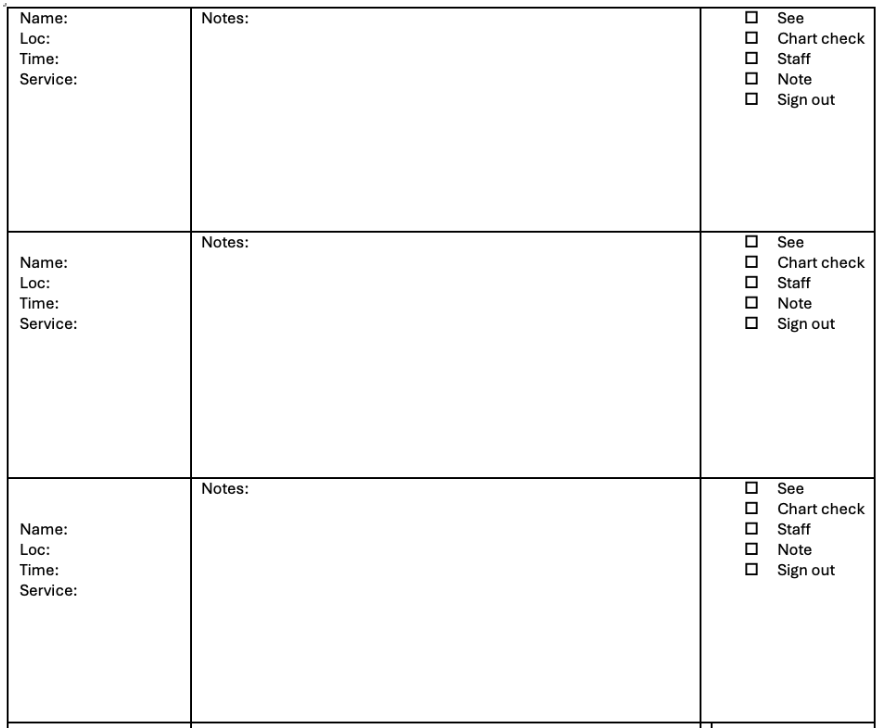
Example “consult sheet” that you can prep and print to help you stay organized
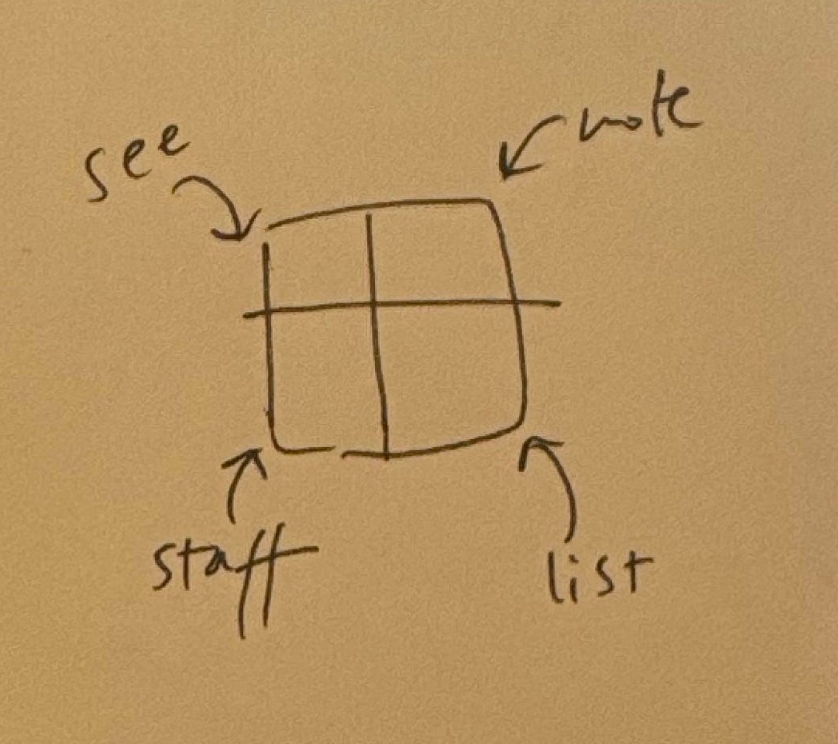
I like that this is a purely visual system, bringing the comfort and order of a bubble test or a paint-by-number to the chaos of consult life.
- Specifics for surgery: if a patient is potentially going to the OR within the next 24 hours, you need to ask the “OR readiness” questions in addition to getting your consult history. This should become a mental (or physical) checklist that you go through reflexively: when did they last eat/are they NPO now? For female patients do they need a pre-op pregnancy test? Are they on blood thinners/could they potentially need blood and if so do they have an active type and screen and a blood consent? Can they consent for themselves? If not, who consents for them? You don’t want to say “uhhh” when your senior asks you one of these questions.
- Physical exam: if you are potentially going to be operating on this patient, you need to examine the surgical site. This may seem obvious, but it gets skipped: if there’s a dressing, you need to take it down. Be on the lookout for preexisting scars or other injuries, and if you see anything unexpected, ask the patient about it.
Staffing the consult:
- This part of the process is highly variable depending on the culture of your specific program. Maybe you need to call a senior resident or an attending, maybe it’s just an email or a text, maybe you just cosign to an attending and that’s it. The important thing is that you find out how you are expected to staff consults on the specific service you are on. Ask the person who was on service before you, or reach out to your senior resident or attending (at the start of your shift - don’t leave it til the middle of the night!) and ask how they want to be informed about consults during your shift. I promise, they’ll appreciate you asking; it shows that you’re serious about your job.
- Regardless of the form your staffing takes, remember: your job as the consult resident is to propose a PLAN, not just report a history and exam. You can be wrong, and if/when you are, your senior or attending will correct you, and you’ll learn something. Don’t think of staffing a consult as asking what you should do, staffing a consult is proposing a plan and asking for feedback.
- Instead of saying “I have a consult for you,” try to say “I have an urgent/non-urgent operative/nonoperative consult for you” so the person you’re talking to can adjust their mindset to receive the rest of the info. Remember that this process is stressful for your senior/attending too and try to understand their situation: are you about to throw a wrench in their elective case schedule? Do they need to put pants on and start making their way to the hospital?
Writing your note:
- Consult notes are much more important than the daily progress notes you wrote as an intern. Consult notes are a touchstone in the chart, and should be a complete assessment of that patient’s issue, from your specialty’s perspective, at that point in time. Think of your colleague who might get called for this same patient again in the future: write them the note that you would want for yourself. Thorough history, thorough exam, complete plan.
- Make dot phrases or templates for your most common consults, with triggers to ask/document the key info you need. For example, I often forget to ask hand consult patients what they do for work, and if they are right or left handed (questions you should ask basically every hand consult), so I have those questions in my dot phrase to help me remember. I also have templates for common procedures like I&Ds, lac repairs, and reductions since those tend to be pretty standardized. To paraphrase Sonia, idiot proof your life for future tired, idiot you.
It’s tempting to want to squirrel away somewhere to do your documentation in peace, but I usually try to write my note near the patient’s room. That way, if you forgot to ask something or look at something, you can pop back in easily. Plus, it keeps you focused and efficient: you’ll be motivated to get it done and get out of there. Keep the hospital at the hospital.
The consult isn’t done until you close it out:
- Call or message the consulting service: don’t just leave a note in the chart and assume they’ll see it. Actually talk to them and give them the opportunity to ask clarifying questions.
- If this patient will be followed during an admission, communicate with whoever will be responsible for following them.
- If this patient is going to follow up in clinic, make sure somebody knows to expect them and that the patient knows how to get in touch with them.
If you’re struggling with consults…
- Talk to your peers! Odds are, what you’re experiencing is normal. Plus, you’ll pick up all kinds of great tips and ideas by talking to the other people who do your same job.
- Talk to your seniors! I did a lot of Monday-morning-quarterbacking where I’d ask my seniors or even attendings what they thought about certain consults or what they would have done differently. If you ask during normal work hours, for the most part people are happy to share their opinions, and I felt like asking lots of questions during the day helped me avoid having to wake people up at night the next time that same consult issue came up.
- Pick an organizational system and stick to it: having good habits is the best way to get faster and, as the epigraph says, protect yourself from making mistakes when you inevitably get tired and overwhelmed later in the shift.
.jpg)
.jpg)
.jpg)
.jpg)