
What London’s Black Cabs Reveal About Medicine, AI, and the Human Need for Mastery
In London, there is still a profession built on an almost stubborn refusal to outsource thinking.
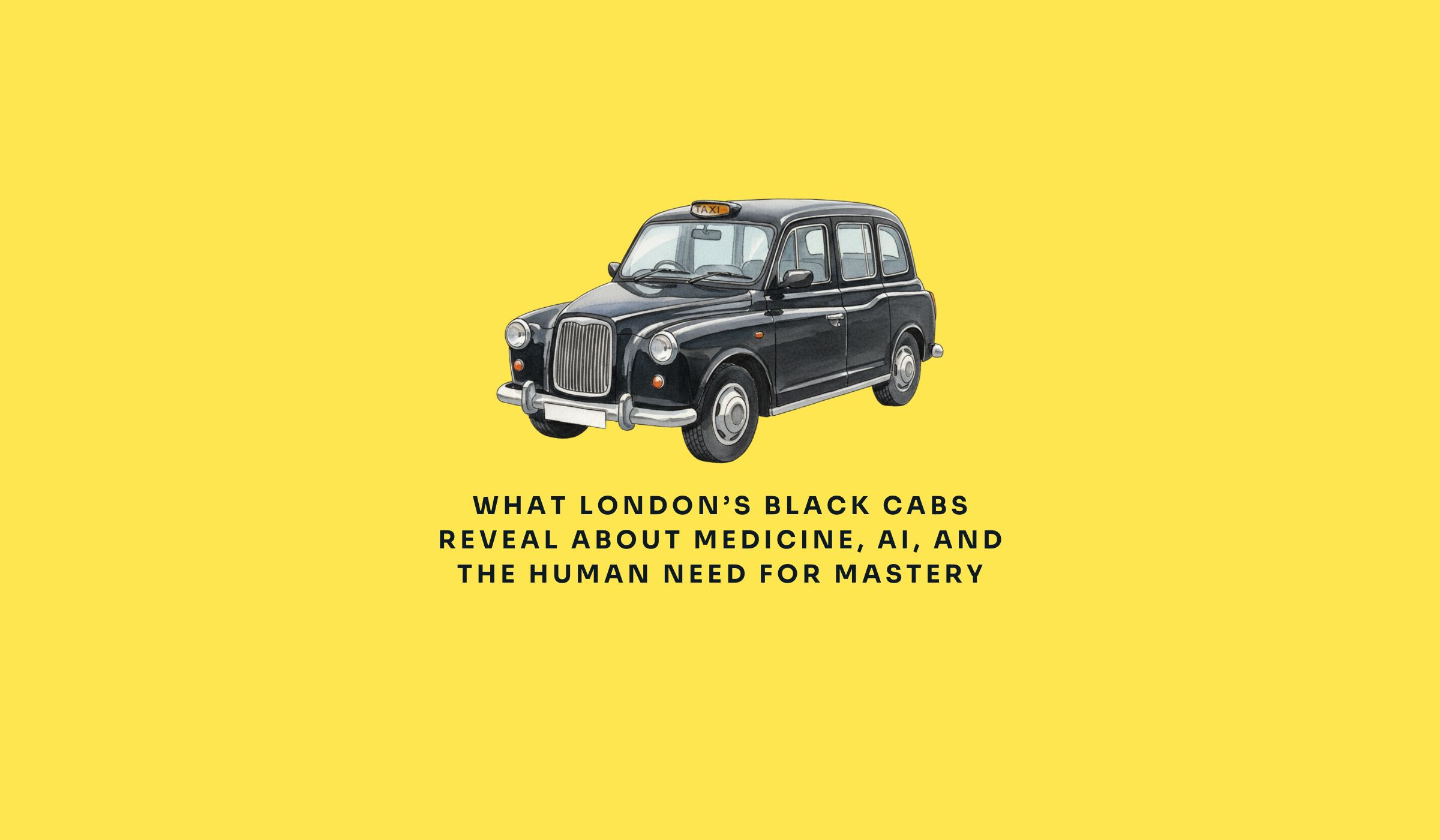
To drive a traditional black cab, one must pass The Knowledge, a legendary exam requiring the memorization of more than 25,000 streets and thousands of landmarks within a six-mile radius of Charing Cross. Candidates spend years studying, riding mopeds through the city, reciting routes aloud, and learning not just where streets are, but how they connect, how traffic flows, how the city behaves.
All of this persists despite GPS, satellite imagery, real-time traffic data, and ride-hailing apps capable of plotting a route instantly.
From a purely practical standpoint, the commitment feels irrational. Why devote so much of one’s life to internalizing information that can be accessed at the tap of a screen?
And yet, The Knowledge endures, diminished perhaps, pressured by economics and technology, but still alive. Its persistence raises a deeper question, one that increasingly applies to medicine:
Why do humans still pursue mastery when convenience is everywhere?
Instant Information vs. Internalized Understanding
Medicine now finds itself at a similar crossroads. AI systems generate differential diagnoses in seconds. Telehealth platforms remove the need for physical presence. Clinical guidelines, protocols, and decision trees are always within reach. In many settings, the physician appears less like a singular authority and more like an intermediary between patient and system.
Against this backdrop, the choice facing an 18-year-old today becomes stark: why spend more than a decade training to become a doctor at all?
Why commit years to memorizing anatomy, physiology, pathology, and pharmacology when nearly all of it can be retrieved instantly?
One answer is practical: because retrieving information is not the same as exercising judgment. But that explanation only goes so far.
At a deeper level, mastery satisfies something fundamental in the human condition - something older than efficiency, and far more durable than any particular technology.
What Mastery Actually Gives Us
A London cabbie doesn’t merely know routes; they know possibilities. They understand how to respond when a road closes unexpectedly, when traffic patterns shift, when a passenger’s request hints at a better destination than the one stated aloud. Their knowledge is flexible, adaptive, and embodied.
Neuroscience reflects this depth. Studies have shown that cab drivers’ brains physically change as they acquire mastery: the hippocampus, associated with spatial memory, grows. When knowledge is deeply internalized, it becomes part of the self.
Medicine operates in much the same way. A physician who has truly learned their craft does not simply apply rules. They synthesize biological, psychological, and social variables, often under conditions of uncertainty. They notice what doesn’t fit. They sense when something is wrong before they can fully articulate why.
This kind of knowing resists full externalization. It is more than just data. It is experience integrated over time.
Autonomy, Not Just Accuracy
There is something else at stake here as well: freedom.
To know something deeply is to operate with a degree of independence from tools, systems, and corporations. The black cab driver does not rely on a signal, a subscription, or an algorithm built by someone else. They act on their own authority.
In medicine, that distinction matters profoundly.
Physicians who understand their discipline at a deep level can recognize when protocols fail, when metrics distort reality, or when technology introduces friction instead of clarity. They can focus on the patient in front of them, rather than the abstraction defined by the system.
Technology offers efficiency, until it doesn’t. Mastery is slower, harder, and more costly, but it endures under pressure.
Why We Still Trust People
Despite unprecedented access to information, people continue to seek out human experts. Patients still want to sit across from physicians. Families still ask, “What would you do if this were your loved one?”
This preference isn’t driven by a lack of faith in technology. It reflects something else: trust is relational.
A human expert can explain not only what to do, but why a recommendation makes sense in this specific context. They can be questioned, challenged, reassured. They can take responsibility for uncertainty.
Algorithms optimize. Humans own decisions.
That difference becomes especially meaningful when stakes are high, when outcomes are unclear, values conflict, or no single “right” answer exists.
The Hidden Cost of Outsourcing Understanding
Convenience carries a quieter tradeoff. Each time understanding is outsourced, a degree of independence is surrendered. Dependence shifts not just to tools, but to the institutions that control them - corporations, platforms, and systems shaped by incentives beyond individual care.
A cabbie who knows London cannot be nudged by surge pricing or routed for efficiency at the expense of the passenger’s experience. A physician who understands their craft can push back against productivity pressures, checkbox medicine, and algorithmic shortcuts when they conflict with patient needs.
Seen this way, mastery is not nostalgia. It is a form of resistance.
That said, most physicians today are not independent operators. Quite the opposite: private practices are rapidly disappearing, and healthcare has become as focused on capital extraction as many other industries. Physicians increasingly practice within large, consolidated organizations shaped by reimbursement models, productivity targets, and algorithmic oversight.
Even so, deep mastery still alters how a physician can move within whatever system comes next. The healthcare landscape over the next five to ten years will almost certainly look very different - defined by new care models, ownership structures, technologies, and definitions of value. Physicians who have internalized their knowledge are better positioned to adapt, to lead, and to recognize opportunities that cannot yet be named. As workflows change and institutions reorganize, mastery becomes portability: the ability to step into new roles, shape emerging models of care, or operate meaningfully as the ground shifts.
Why Humans Choose the Long Way
At its core, the pursuit of mastery has never been about usefulness alone. It speaks to dignity, agency, and meaning.
Across history, humans have chosen the harder path: memorizing poetry in an age of writing, practicing instruments in an age of recordings, studying philosophy in an age of answers. These choices persist not because they are efficient, but because knowing something deeply reshapes who we are.
The Knowledge is more than an exam. It is a declaration that certain forms of understanding are worth carrying inside oneself, even when external tools exist.
At its best, medicine makes the same declaration.
A Future With Technology and With Experts
The future of healthcare will undoubtedly include AI, telehealth, automation, and digital tools, just as London now includes GPS alongside black cabs. The question is not whether technology belongs (it does) but whether we continue to value the human capacity to know deeply, judge wisely, and act independently.
AI may never fully replace physicians. The greater risk is that we stop valuing the kind of mastery that makes physicians more than system operators.
The Knowledge survives not because it is the fastest way across London, but because it preserves something essential: the human desire to understand the world well enough to navigate it on our own terms.
That desire is not obsolete.
Neither is the physician.
.jpg)

.jpg)
.jpg)
.jpg)