

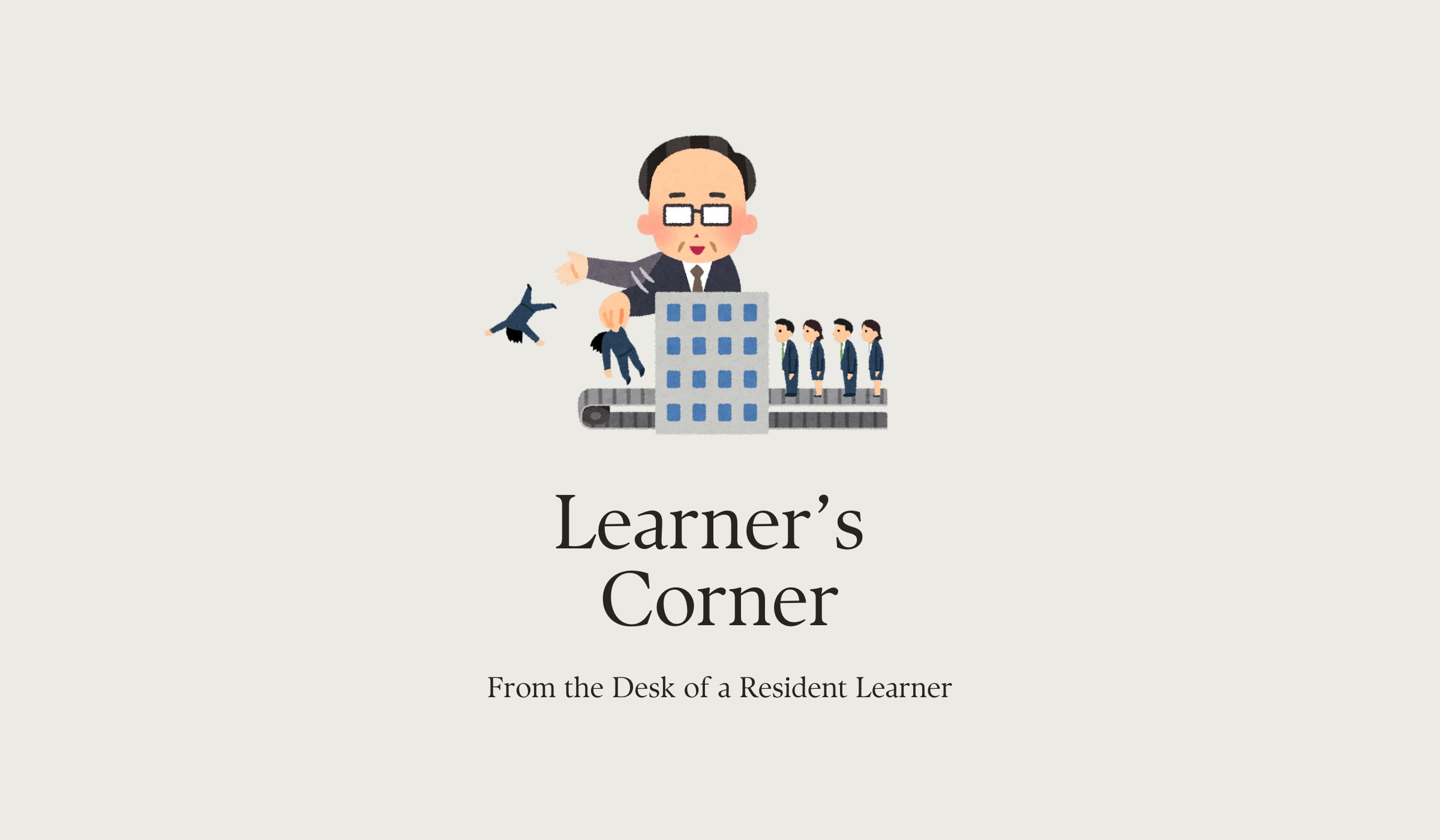
I adjust the straps of my brand new JanSport backpack, take a deep breath of that just-outside-of-the-hospital air (it’s mostly cigarette smoke coming from a guy in a wheelchair with an oxygen tank), check that my Dansko’s are squeaky clean, and walk through the automatic doors into the lobby. It’s my first day of school! Well technically it’s my first day of ENT residency, but as I’ve been told by many older physicians and User192093029238 on Tiktok, I’m still a LearnerTM. Which means that even though I’m about to turn 28 years old, I have still never had a Real Job and won’t until I’m at least 33!
I’m so grateful that all of these wise Attending Teachers and PGY2-5 Learners have agreed to dedicate a significant amount of their time and energy towards teaching and nurturing my development as a Physician Learner. As the morning starts, I do find it a bit odd that no Attending Teachers show up for learning rounds. But that’s ok - who said I can’t learn things from another Learner!
The first thing I’m taught is to Shut Up. We are talking to a patient at bedside and I can’t quite make out what she is saying, so I ask her to repeat herself. Apparently that’s not what Intern Learners are supposed to do though. But now that I’ve learned that important lesson, I’m already one step closer to being a real doctor.
Throughout that first magical day, I learn how to:
- Stand quietly in the corner of the OR
- Answer trivia questions about The Rolling Stones
- Transport a patient from the OR to the PACU
- Skip lunch
I call my wife as I leave the hospital at 6:30pm. She asks if I made enough money to feed her and our 2 young children tonight. I tell her that I did not, but I’m sure since I am a Learner, I can apply for some sort of scholarship to help us out. She tells me that I’m an idiot and hangs up. I think she’s under the impression that she married a 28 year old physician who works a real job. Unfortunately, that is not the case.
By the end of the week, I’m told that I need to log my duty hours. I am encouraged by the fact that my program is so interested in my learning development that they want to know just how many hours I’ve spent learning this week. With my PGY5 Learner looking over my shoulder, I log 85 hours. He says, no - change it 80. I don’t quite understand, but I do what I’m told. He must find it embarrassing that it took me 85 hours to learn what could have been learned in 80, and doesn’t want our team to look like we don’t learn efficiently.
I also wonder if the department perhaps only has enough Learner Tokens to account for 80 hours per week from each Learner. That has to be it. I think I’ve heard people talking about how the ACGME gives out token guidelines to each program. Since I’m not an employee of the hospital and this isn’t a real job, it shouldn’t matter how many hours I log. It’s not like I’m getting paid overtime for learning extra hard.
By the end of week two, I begin to understand the rhythm of my education.
I arrive before the sun rises, because learning is best absorbed in darkness. The hospital is quiet then, which gives me time to pre-learn on my patients before anyone else arrives to teach me. I log into the computer and, through a process of self-directed discovery, learn about their overnight labs, imaging, medications, histories, and occasionally their names.
On learning rounds, I present everything I’ve learned to my fellow Learners, who listen carefully so they can also learn what I have learned. Occasionally, an Attending Teacher appears and asks a question about a randomized controlled trial from 1997. I do not know the answer, which is good, because it means I still have so much to learn.
A senior Learner hands me a consent form and tells me to go take care of it. I am thrilled. Finally, hands-on teaching! I walk into the patient’s room and, using the communication skills I learned by being told to shut up, I obtain informed consent for a procedure I have never seen performed.
Experiential learning.
Later, in the OR, I stand very still and learn. Sometimes I hold a retractor, which I assume is the surgical equivalent of proof that I am actively participating in the lesson. My arms begin to shake, but I do not move. This is likely part of the curriculum.
Endurance module.
At some point, a scrub tech asks me to adjust the light. I do it wrong. This is another valuable learning opportunity.
I learn how to place orders on 14 patients simultaneously while answering pages, seeing consults, updating families, and locating a missing wheelchair. This integrated learning environment helps simulate real-world conditions, like if a pilot had to fly a plane while also building it and explaining aviation to passengers mid-flight.
At home, my wife has stopped asking about my day. Instead, she asks if I can pick up groceries on the way home. I tell her I’d love to, but I am scheduled to learn until 7:30pm, after which I will participate in independent study (also known as “finishing notes”) for several additional hours. She asks if I get paid extra for that. I laugh - students don’t get paid, silly!
One day, a medical student asks me what it’s like to be a resident. I tell them it’s an incredible opportunity to learn at an accelerated pace. They ask if it’s hard. I tell them no, it’s actually very fair. After all, I am not an employee. I am a Learner. A 28-year-old Learner with a doctoral degree, six figures of debt, a full patient load, and just enough authority to be accountable but not enough to matter. It’s just like medical school, except better. They seem reassured.
As I walk out of the hospital that night, I see the same man outside with the oxygen tank. He nods at me. I nod back. We are both, in our own way, learning how the hospital works. And I, for one, am grateful to be a Learner.
.jpg)
%20(4).jpg)
.png)
%20(1).jpg)
.jpg)