

"Can you see one more patient?"
It was 4:17 p.m. My clinic notes were finished. For the first time that week, I was going to hit the gym before heading home to make dinner.
Before my office manager finished her sentence, I already knew what I was going to say.
“Absolutely."
The word came out of my mouth like a knee responding to a reflex hammer. My jaw and shoulders tightened reflexively. Somewhere deep in my chest, my body protested.
I ignored all of that and smiled. "No problem at all."
When we think of trauma responses in medicine, we often imagine the deer-in-the-headlights look on a med student’s face when they are pimped on rounds: a classic example of the freeze response.
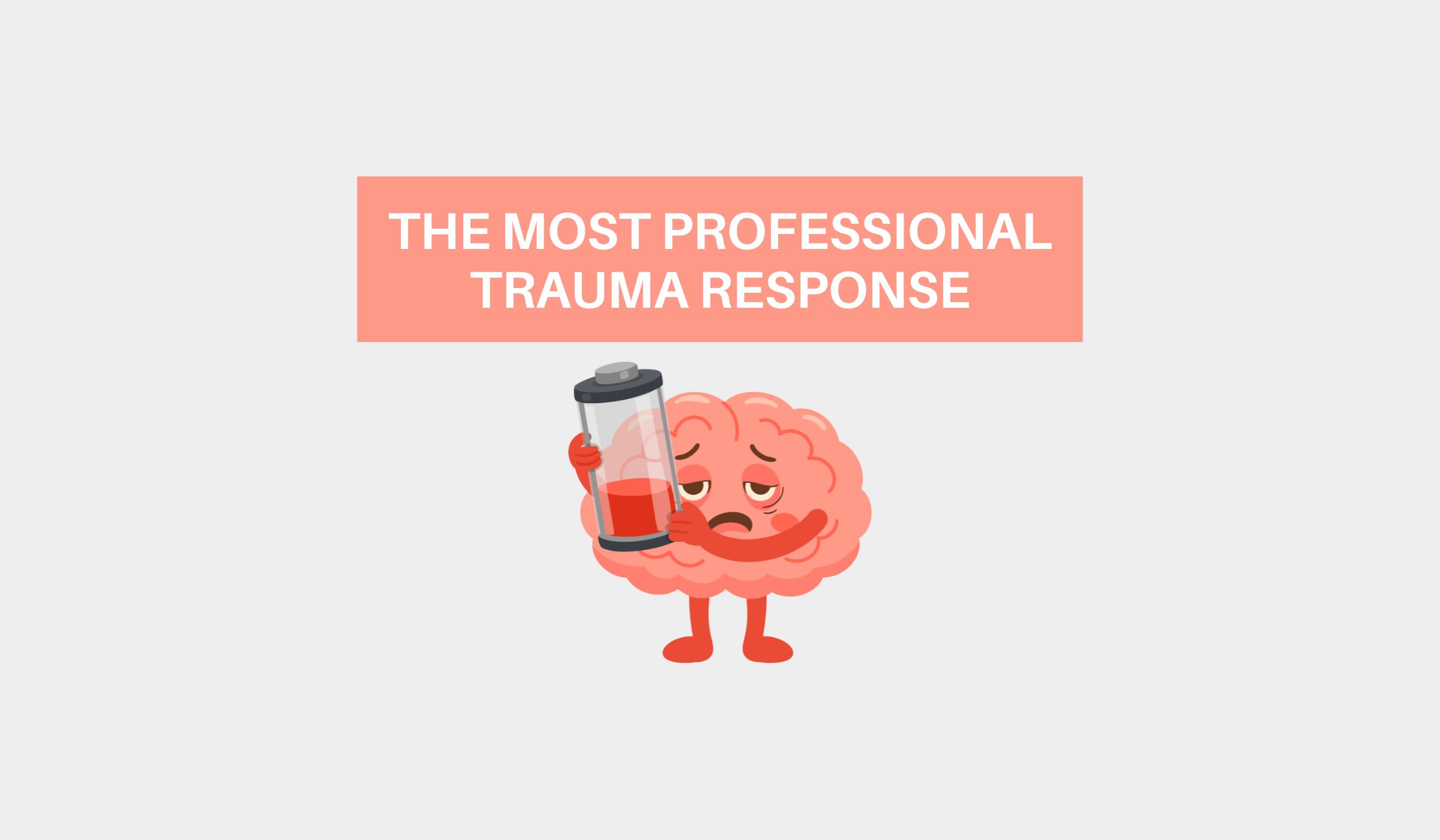
But one of the most common trauma responses in medicine looks remarkably professional.
It smiles. It volunteers to go the extra mile. It says, "Happy to help." It stays late. It apologizes. It overexplains. It avoids conflict. It becomes the team player everyone loves, all while we abandon ourselves.
The Internal Wiring
Trauma therapists describe five ways the nervous system responds to threat: fight, flight, freeze, flop, and fawn.¹ ²
Interestingly, the threat doesn't have to be real to trigger the response. Our threat-detection circuitry evolved for predators, and it errs heavily on the side of caution, so it can react to a furrowed brow much the way it reacts to a growl. To our amygdala, an agenda-less “we need to meet" email from the boss can light up the same alarm pathways as something with teeth. A briskly bleeding vessel in the OR registers, physiologically, as a personal attack.
When the alarm sounds, the body mobilizes. Epinephrine and norepinephrine surge. Our heart races, our face flushes, breathing quickens, and blood shunts to our muscles.³ The body wants to move: to either fight the threat or flee it. If you've ever wanted to scream at the patient who implied you were derelict for not sending a culture, that was fight. If you've ever wanted to shove a lap on a bleeding wound and run straight out of the OR, that was flight.
When fighting and fleeing both feel unsafe, the body has three more options. Freeze traps the mobilized charge inside the body until the threat passes, which is why prey animals tremble visibly after a close call–a phenomenon somatic therapists interpret as the body discharging what it stored.⁴ Flop, or dorsal vagal shutdown, is the last resort, when the system becomes so overwhelmed that it collapses, much like a possum playing dead.⁵
And then there is fawn, the most fascinating of the five.
Fawning is appeasing, placating, or pleasing another because the nervous system believes that the other could harm us. You can watch it across the animal kingdom: when a lower-ranking wolf encounters a dominant one, it lowers its body, tucks its tail, and licks the other's muzzle. The message is unmistakable: I'm not a threat to you. Please don't hurt me.⁶
Psychotherapist Pete Walker, who coined the term, describes fawning as seeking safety by merging with the wishes, needs, and demands of others.¹
In modern human culture, it’s called people-pleasing.
Every time we suppress our authentic response because we believe our acceptance depends on it, we are fawning.
Fawning as Physicians
When you get paged at 2 a.m. and make your voice sound pleasant instead of exhausted, you are fawning. When your office manager asks about double-booking a patient, and inside you're thinking absolutely not, I want to go home, but out comes a sing-song "No problem at all!”, you are fawning. When you were an intern resentfully doing scut work, you were fawning. When a patient requests an unnecessary test and you order it while swallowing your objection, you are fawning.
Medicine's visible curriculum teaches us how to diagnose disease, treat based on evidence-based guidelines, and manage the patient in follow-up. But the invisible curriculum teaches us which parts of ourselves are acceptable, which emotions are safe, and which desires should be sacrificed in the name of belonging.
In the face of fawning, "team player" takes on a different meaning. We assume a team player is the one who always says yes, never complains or rocks the boat, and always picks up the extra work with a smile. But that's not really teamwork. That's survival.
The Impact
The cost of fawning is incredibly expensive for the individual.
The word integrity comes from the same Latin root as integer, meaning whole, intact, and undivided. An airplane loses structural integrity when its wings begin separating from the fuselage. A human loses integrity when their outer life becomes separated from their inner truth.
One "yes" we didn't mean. A swallowed opinion. Another double-booked patient. That unpaid committee position. The forced smile. Every time we agree to fill out a form we believe is unnecessary.
Eventually two versions of ourselves emerge: the one our colleagues and coworkers know, and the one who lives inside our own body. The farther those two people drift apart, the more we suffer. Some of us drift so far that we no longer know what we truly want because we stopped asking decades ago.
Let me be clear: fawning is not a moral failing. It's not even wrong. Fawning is an intelligent adaptation. It can be life-saving. For instance, if you're being robbed at gunpoint, appeasement is precisely the right move. And a measure of social smoothing is kindness: it's good that we don't unload our irritation on the ER physician calling at 2 a.m. He doesn't want to be there either.
In fact, the biggest fawners in training are often the ones who make it far. Institutions reward compliance. Evolution rewards survival. Neither one is particularly interested in your authenticity.
The problem isn't that we fawn. The problem is when fawning becomes perpetual, meaning the override is so automatic that we mistake it for our personality. When we choose short-term comfort and long-term resentment so many times that animosity becomes our norm.
Getting Back Into Integrity
So how do we break the cycle?
The first step is to consult a source of information most of us were trained to ignore: the body.
Your body renders a verdict on every request before your mouth answers. It constricts when it means no: the tight jaw, rising shoulders, and knot in the chest. It softens and opens when it means yes.
Next time your office manager asks you to double-book, pause for one breath and check. Tense or relaxed? If the answer is tense, that doesn't necessarily mean you decline. It means you now know the truth. You can still say, "Sure, I'll see them”, but you say it knowing you are choosing to override your body consciously. That single act of awareness is the difference between abandoning yourself and making a sacrifice.
Then draw a line. Override for the essentials and the non-essentials you genuinely choose. The middle-of-the-night consult while on call is an essential. But when admin wants one more signature on one more form because it's "policy," and your body constricts, that might be the moment to stand your ground. Imagine how many non-essential tasks would evaporate from our days if we all stopped agreeing to go along with “policy.”
One nuance matters here. Fear alone is not a no. We will always feel fear when we take a real risk or push past the edge of our comfort zone. The difference is in the direction of the pull. A true yes feels like being drawn toward something, fear and all. A true no feels like pushing or dragging yourself toward something that your body recoils from, often with a faint note of disgust.
When I decided to leave my decade-long career in private practice for the unknown of entrepreneurship, I felt plenty of fear. But the decision pulled me. When I imagine returning to life as a full-time surgeon, I recoil. That's my body saying no. Fear accompanies both paths. Yearning accompanies only one. Our job is to follow the yearning and bring the fear along with us.
Choosing, Not Reacting
I don't believe freedom comes from saying no to everything. Nor do I believe integrity requires that we obey every impulse our body sends us.
Sometimes the right thing to do is still the hard thing. We answer the middle-of-the-night consult when we are on call because that’s our duty. Sometimes we stay late. Sometimes we double-book the patient.
The difference is that a free person chooses, while a fawning person acts against their will.
One action comes from service and the other from fear. The behaviors may look identical from the outside, but the nervous system knows the difference.
Physicians do not need to say no to everything, but we can remember that no is always an option. A yes that is chosen freely is generosity; a yes extracted from fear is self-betrayal.
Every time we abandon ourselves to preserve belonging, we make our world a little smaller. And every time we honor what is true inside us, even when we ultimately choose sacrifice, we become a little more whole.
Integrity isn't about always getting it right, but instead checking in with the desire of your body before you decide what your mouth will say.
Notes & References
- Cannon, W. B. (1915). Bodily changes in pain, hunger, fear and rage: An account of the recent researches into the function of emotional excitement. D. Appleton & Company.
- Darwin, C. (1872). The expression of the emotions in man and animals. John Murray.
- Levine, P. A. (1997). Waking the tiger: Healing trauma. North Atlantic Books.
- Lodrick, Z. (2007). Psychological trauma – What every trauma worker should know. The British Journal of Psychotherapy Integration, 4(2). [verify volume/pages against your copy]
- Porges, S. W. (2011). The polyvagal theory: Neurophysiological foundations of emotions, attachment, communication, and self-regulation. W. W. Norton & Company.
- Walker, P. (2003, January/February). Codependency, trauma and the fawn response. The East Bay Therapist.
- Walker, P. (2013). Complex PTSD: From surviving to thriving: A guide and map for recovering from childhood trauma. Azure Coyote Publishing.
.jpg)
.jpg)
%20(3).jpg)
.jpg)
.jpg)