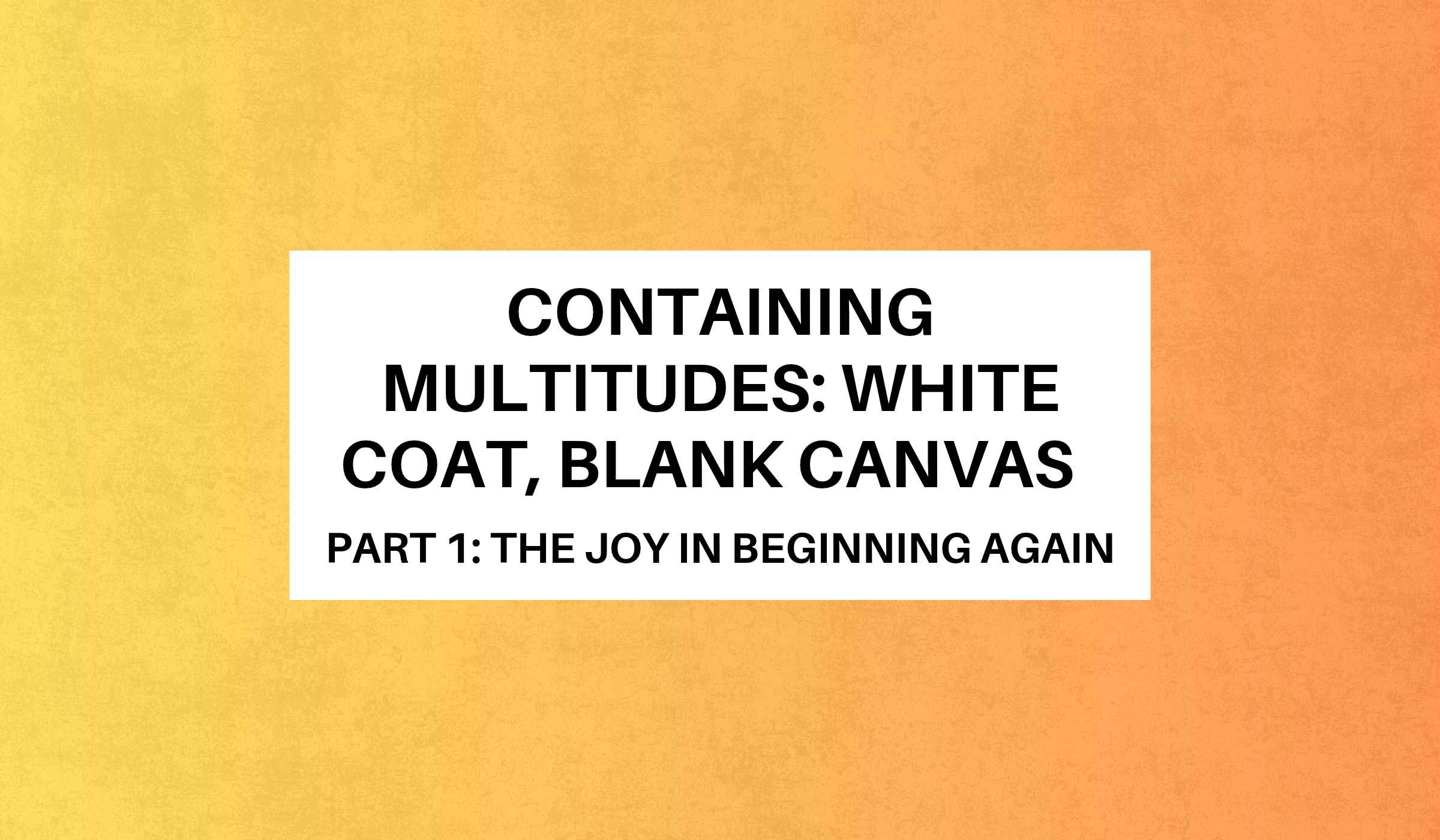
Part 1: The joy in beginning again
“Were you always an artist?” a gray-haired woman with flashy ultramarine blue glasses asks me, standing in front of my painting hanging in its first gallery show.
I pause, trying to calculate the correct response. Is there a prerequisite for being an artist? A minimum number of childhood watercolors? A formative summer at an easel where the universe whispered “This one will make art”? Does one need to have suffered artistically before age twelve?
“No, actually,” I eventually managed. “Not at all.”
▬
As a premed, I never imagined I would be anything other than a medical student. As a medical student, I never imagined I would be anything other than a doctor. At every stage, the next version of myself seemed obvious, inevitable, and helpfully printed on the next set of identification badges.
Then I became an attending. The big girl doctor version of myself arrived, did her job, and left me with a question I had not prepared for on any exam: Now what?
At no point in this sequence did anyone hand me a brochure titled Other Things You Might Like to Do With Your One Wild and Precious Life.
After all, where, exactly, is the time or energy to be anything or anyone other than what I am at this precise moment?
And yet, for me, life after training has shown me this truth: I am meant to contain multitudes.
I had a particularly straight and narrow path into medicine. In fact, I was in a combined BS-MD program where I was essentially foretold, just freshly out of high school,“You are going to be a doctor” by an admissions committee. There would be no studying abroad, no gap year, no just-for-fun college classes because they sounded interesting. The future had been decided with the reassuring efficiency of a well-run clinic.
For a long time, I was happy to let it be decided. I found the certainty comforting. Until it wasn’t anymore. There are only so many times catching up with friends that I could stand having nothing else to talk about except what happened inside hospital walls.
When I finished residency, I became consumed with all the other versions of myself I had never gotten to know.
So on a whim, I found myself signing up for a drawing class on a Saturday morning at my local arts center. Drawing for the Absolute Beginner.
The tiny egomaniac in the back of my head was saying, “Absolute beginner, pfffft. Surely there is a more advanced option than that.” But the normal adult human in me, nervous to try something new, countered, “Approachable enough to start.”
Armed with a supply list of various types of papers, graphite, and charcoal that read like a foreign language, I went off to the serious art supply store down by the university’s art school. I felt dumb being nervous to go, because I obviously wanted to look like I knew what I was doing (I did not).
I glanced nervously back and forth from my list to the shelves.
Vine charcoal?
4B graphite pencil?
Is there a difference between graphite and charcoal anyways?
And literally what is 105 gsm paper?
I once heard someone say that, for doctors, thirties are the new adolescence. My twenties were not the messy years where I tried everything, failed, made mistakes, and reinvented myself ten times over.
By the time I emerged from the cave of education and training, I was a fully grown adult who could manage a complicated medical problem but not enter an art supply store without feeling like I had accidentally wandered into someone else's life.
I felt that the further I funnelled into my training and career, the harder it would become to step into something new.
And so, on a crisp fall Saturday, I put on my biggest big girl pants and went to the class I signed up for.
For fun. I had to remind myself.
A bubbly instructor with spiky short hair walked in and began making introductions. With the confidence of someone who never once wondered whether they should be an art class, she explained our first warm-up exercise.
It would be simple. We would each receive a piece of ordinary computer paper, draw a heart, and color it in.
Excellent. A heart. I know hearts. Surely I could manage a cartoon representation of the organ, or at least its symbolic equivalent. Feeling good, I pulled out the materials I managed to successfully acquire. I drew the heart, put some color around and in it, and looked at it .
With a moment of pause, I squinted down at what looked to be the stupidest thing I had ever created. It was out of proportion, weirdly skinny towards the bottom. The colors selected by someone who had recently discovered they were actually color blind.
Like a kid protecting their quiz from wandering eyes, I instinctively curled my body around the page.
“Now everyone will get a piece of tape and bring their drawing up to the board,” the instructor said plainly. I could feel my body tense up, bracing for dejection. A critique on the first class? What in the world was I doing here?
Slowly, each person rose from their stools and followed instructions. If anything, my medical training proved I am good at following rules, so I followed suit, took my wonky heart up, and taped it to the corner of the board. Instead of the corner being the safe spot for my drawing to hide, the instructor grabbed mine first, and moved it straight to the middle of the board.
“What do we like about this one?” she asked.
I wanted to disappear inside myself and slither out the open window. Other students awkwardly glanced at each other waiting to see who would take the first bite. Silence. I thought about how I should have been studying for boards anyways.
“I’ll go first,” our instructor chimes in.
Can anyone else hear my heartbeat at this point?
“I am really enjoying the contrast between the wide lines at the top, and the more narrow playful lines at the bottom.”
Wait, was that a compliment?
“You can really feel the energy moving from the center towards the top right corner of the page in the way you’ve arranged color here.”
I did that? I had arranged the color?
“Well done, Rachel. Let’s take this one next.”
In that one minute, the tension in my chest was cut with a knife. But the knife was a butter knife, and I was one of those already softened sticks of margarine.
In medicine, we come from a world where even our best efforts can frequently be ‘not enough.’ A minor detail omitted during rounds. Or even included, but deemed not relevant this time. A suture cut the length the last surgeon taught you to, but not the length this surgeon prefers. A meeting missed to spend extra time taking care of a patient problem, followed by an email questioning why you really missed the meeting.
In medicine, we come from a world where the things that we love about ourselves can be just as easily torn down by someone else with a passing comment, a performance evaluation, or a system that has confused the vastness of the human experience with a checklist. I will never forget the standardized patient who told me as a medical student that my “smile was just too big.”
In medicine, we become very good at identifying what is wrong. It is, after all, an essential part of the job. But somewhere along the way, we can become so accustomed to searching for deficits that we forget how to look at anything - let alone ourselves - without first asking what needs correcting.
And yet here in a concrete room, surrounded by a bunch of strangers, in an arts center on a random Saturday morning, I was told that I made something worth looking at.
I am not being bashful, my drawing was not secretly good. I was still a beginner with a fumbling hand. But my best effort had been met with curiosity instead of correction, with generosity instead of judgement. Someone had seen something on my paper that I hadn’t intended, and instead of telling me what was wrong with it, she helped me see what was there.
For the first time in a long time, I was in a room where I didn’t need to be the most competent version of myself at all times. I didn’t need to justify my presence or explain how this would contribute to my professional development.
I just had to show up and draw a heart.
If the gray-haired woman in her flashy frames would have asked me then, I certainly wouldn’t have called myself an artist after that first drawing class. But I knew one thing for sure: I was a doctor who had been brave enough to be an absolute beginner.
And that choice opened up a new pathway that changed everything for me.